

Transitions
Onboarding to the company.Onboarding to new assignments.Promoting!Internally mobilizing to new roles.Hitting program and project milestones.Moving through turning points along a career path.Going remote!Changing locations.Taking leaves of absence.Offboarding to Retire!Leaving to find a better fit.Changing careers.Departing with unreasonably short notice (it happens!…)
Knowledge in Motion—Worthy of Capture
Workplace transitions usually involve “moves” of some kind: a move down the hall, up the stairs, maybe across the state, maybe out the door. Or simply, on to the next project.
When people are in motion, so is their knowledge. And unless it’s right on the table, in use on current projects—knowledge in motion is vulnerable to loss, disconnection, or misinterpretation.
We’d like to think our individual and organizational memories are strong. That, of course! Someone will remember where things are filed. Or what key lessons were learned on that project 15 months ago.
As a rule, that’s not the case. Hard-earned, recently learned, even foreseeably relevant things are not regularly recorded, organized, filed, or passed along.
Capturing and sharing smart things is always a good idea—for the organization and individuals. At workplace transitions, capturing and managing those smart things minimizes continuity gaps and costs.
Why We Like Transitions for Knowledge Transfer

Some transitions arrive as surprises; others are rushed and time sensitive. Stress happens—even in well-planned, less frenzied transitions. One source of stress: the feeling that insights and information might be lost but not knowing specifically which insights or what kinds of information.
But there’s that push to move forward. Taking action! Staying in motion. It’s our business-bias toward moving quickly to the next item, the next project, the next client.
Yet, just as powerful as our bias to move on—is the pause, when we choose to employ it. The short, strategic pause. Taking a beat. Transitions and completions are reasonable and psychologically-sound points to reflect, assess, and capture what’s been learned. What’s worked and what’s been successful—or not.
When transitions incorporate a few beats, discovery and re-discovery happen. Ideas connect. Risk is managed and cracks (that things fall into) are avoided or minimized. Transition stress is reduced. Onboarding the next person or the next team goes better.
When knowledge capture and “transition management” come together, it’s a fit. The Duly Knowted tools ask questions that pull up useful information that might otherwise be lost or misplaced when people move on, move over, move up or move out.
Who’s Moving
In transitions and in knowledge capture, timing counts. Capture “windows” can be short and are easily missed or addressed too late.
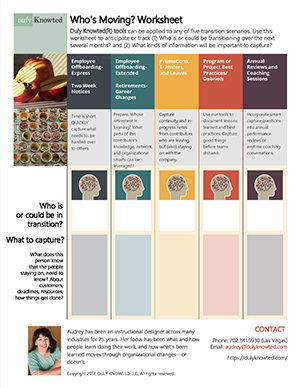
The Who’s Moving Worksheet, downloadable here, offers practice in tracking transitions and the anticipating the types of information that might be at risk.
Who’s Moving? Download
WHO’S MOVING? CAPTURE WORKSHEET!
Our workplaces—your organizations—are in continuous motion with leaders, veteran staff, subject matter experts, high-potential employees…
- Moving ON to new teams and projects, and through work anniversaries…
- Moving UP with promotions…
- Moving OVER with transfers…
- Moving OUT with retirements, career shifts, and job changes…
Timing counts in transitions and in knowledge capture. Capture “windows” can be short and easily missed or addressed too late. Our downloadable Who’s Moving Worksheet helps track transitions and the types of knowledge possibly at risk.
The Who’s Moving Worksheet prompts you to assess and make a few notes— about who is or soon could be moving. What do transitioning people know that you need to know about (for example) projects in progress, your best customers, or where useful documents are filed? What information should be passed along to a successor/replacement?
Please complete the following for access to the free download. Please avoid using free email accounts like yahoo, hotmail, gmail, etc.